
Cassette Beasts on Smartphones: How Monster Fusion Changes the Creature-Collecting RPG Formula
Cassette Beasts arrived on iOS and Android after establishing itself as a distinctive creature-collecting RPG on computers and consoles, but the move to smartphones did not turn it into a simplified spin-off. The core idea remains intact: people stranded on the island of New Wirral record monsters onto cassette tapes, play those recordings to transform into the creatures themselves, and use their forms in turn-based battles. What separates the game most clearly from the familiar catch-and-train formula is its Fusion System. Two monster forms can temporarily become one, combining characteristics that would normally belong to separate team members. On a smartphone, where an RPG may be played in anything from a short break to a long evening session, this system gives each collected creature more possible uses. Building a collection is therefore only the first part of the process. The more important question is how those forms can work together.
From Collecting Monsters to Becoming and Combining Them
Traditional creature-collecting RPGs usually keep a clear boundary between the player character and the creatures in the party. The trainer gives instructions while individual monsters perform the fighting. Cassette Beasts changes that relationship. Monsters encountered around New Wirral can be recorded onto cassette tapes, and playing a tape transforms a human character into the recorded creature. The collection therefore functions less like a group of separate pets and more like a library of forms that the player and companions can use. A cassette can be changed when a different role is required, encouraging players to think about what each recording contributes rather than treating one favourite creature as a permanent answer to every battle.
This distinction matters because Cassette Beasts does not make collecting an isolated activity. Monster forms are connected to combat, movement through New Wirral and character progression. Some abilities gained from creatures also help the human character move through the environment, with powers associated with actions such as gliding, swimming, climbing or magnetism. The result is a collection that has practical value outside ordinary battles. Recording another creature can therefore mean adding a new combat option, gaining a useful ability or creating another possible partner for fusion. The familiar satisfaction of filling a bestiary is still present, but it is supported by reasons to use what has been collected rather than simply storing most creatures after they are obtained.
The smartphone edition keeps this central structure rather than replacing it with short matches or a separate mobile progression system. The beginning can be played before the full game is unlocked through a one-time purchase, and the stores describe the release as the same open-world, turn-based RPG built around recording and transforming into monsters. This is important for understanding the mobile edition in 2026: it is primarily a portable version of Cassette Beasts rather than a different game built around daily rewards or repeated microtransactions. That approach suits the fusion mechanic because experimentation depends on having access to the wider RPG systems, companions and collection rather than receiving isolated creatures through a separate mobile economy.
Why Fusion Changes the Meaning of Team Building
The Fusion System creates the biggest break with the conventional idea that every collected creature occupies a fixed place in a battle party. Cassette Beasts allows two monster forms to combine into a new, fully animated fusion. The result borrows from both components rather than simply replacing one monster with a stronger evolutionary stage. This makes the value of a cassette partly dependent on what can be paired with it. A form that seems ordinary when considered alone may become more useful when combined with another tape whose strengths cover its weaknesses or support a particular battle plan. Team building consequently becomes an exercise in combinations rather than a search for a small group of individually dominant creatures.
Fusion is temporary, which is equally important. The two original forms are not permanently consumed or converted into a third collectible monster. Instead, the player can use the combined form during battle and later return to the separate creatures. That keeps experimentation relatively flexible. Trying a combination does not require sacrificing a cassette that took time to obtain, and an unusual pairing can be tested without permanently changing the collection. The design encourages curiosity because a fusion is a tactical state rather than an irreversible breeding or crafting result. For a genre often built around long-term investment in individual monsters, this creates a different kind of attachment: a familiar creature remains valuable because of the number of situations and pairings in which it can participate.
Companions add another layer to the system. Cassette Beasts connects the ability to fuse with the relationship between the main character and the person travelling with them. Spending time with companions and completing their personal stories therefore has a mechanical purpose as well as a narrative one. The fusion is not presented as something two monsters perform independently of their human users; it represents two characters working together while transformed. This link gives the mechanic more context than a conventional combination feature. Party decisions concern both the cassette forms being carried and the companion accompanying the player, so social progression and monster selection influence the same battles instead of developing as completely separate parts of the RPG.
Fusion Makes Battles About Combinations Rather Than Raw Strength
Cassette Beasts uses turn-based combat, but its battles are designed to reward more than choosing an attack that has a familiar elemental advantage. Its type system includes interactions that can create additional effects when different elements meet. An attack may contribute to a status change, alter how another type behaves or create an opportunity that matters on the following turn. Fusion fits naturally into that structure because combining two forms changes the set of tools available at once. A player thinking about fusion is therefore not simply asking which combination produces the largest numbers. The more useful question is what the combined form allows the team to do in the particular battle taking place.
That makes collection size useful in a practical way. A large roster creates more potential responses to different opponents, but success still depends on recognising why a pairing works. One monster might offer useful offensive moves while another contributes a better defensive option or a type that reacts favourably to the enemy’s attacks. Bringing them together can produce a temporary answer to a difficult encounter, while keeping them separate may be preferable when two individual actions are more useful than one combined form. This distinction prevents fusion from making the rest of the collection irrelevant. It adds another decision to team building instead of simply establishing a single superior state that should always be activated as soon as possible.
The visual side of fusion reinforces the same idea. Cassette Beasts generates combined appearances from the two participating monster forms, so fusion also provides a strong element of experimentation for players who enjoy creature design. Seeing how two familiar forms are reinterpreted as one creature gives a reason to test combinations that may not initially appear optimal. That does not mean every pairing is equally useful in combat, but it prevents the system from becoming purely mathematical. Creature-collecting RPGs have always relied partly on the appeal of finding and recognising distinctive designs. Cassette Beasts extends that appeal by asking what two designs might become when joined, making combination itself part of the collecting experience.
Fusion Is a Tactical Choice Rather Than an Automatic Upgrade
A fusion is stronger in several respects because it draws on two monster forms, but combining the pair also means they operate as one battler. This creates an important trade-off. Two separate characters can normally contribute their own actions, while a fusion concentrates their abilities into one combined unit. There are situations in which that concentration is useful, particularly when extra durability or access to both forms’ moves supports the immediate plan. In other situations, keeping two creatures active can provide better control of the battle. Fusion therefore works best as an option that changes the shape of a fight rather than a compulsory transformation that makes every encounter easier.
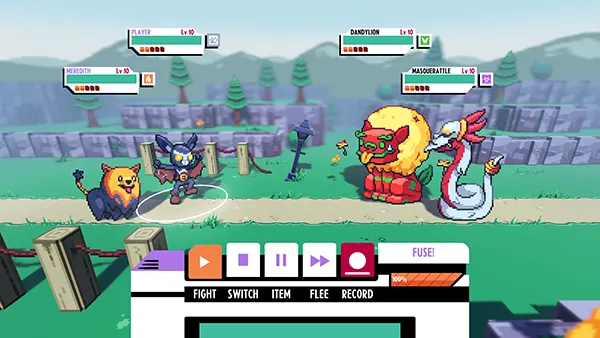
The fusion meter adds timing to that decision. Players do not begin every ordinary battle by immediately merging their current forms. Fusion power is built during combat, so reaching the combined state is tied to what happens during the encounter. This creates a natural rhythm: the player starts with two forms, reacts to the opponent, and may later decide that combining them is worth giving up the flexibility of two separate battlers. Because fusion can also be reversed, the choice is not simply a one-way escalation towards a final state. The player can reassess the situation as health, status effects and available moves change. This keeps the mechanic connected to moment-to-moment decisions rather than treating it as a cinematic reward with little strategic purpose.
Rogue Fusions provide the opposite perspective. Instead of using fusion only as the player’s special ability, Cassette Beasts also turns combined monsters into opponents found around New Wirral. These encounters show what the system can produce when the fusion belongs to the other side of the battle. They also make the mechanic part of the setting rather than a private feature available only to the main character. Meeting unfamiliar combinations encourages players to consider how different forms interact and gives the wider fusion concept a visible role throughout the adventure. This helps Cassette Beasts avoid a common problem in RPG design, where a headline mechanic appears in menus but has little presence in the world or the behaviour of enemies.
Why Cassette Beasts Works Differently as a Smartphone RPG
Moving Cassette Beasts to phones changes the circumstances in which the game is played more than it changes the underlying rules. Turn-based battles are naturally suited to touch input because the player can consider a move without dealing with constant real-time pressure. The same applies to cassette management, party preparation and fusion choices. These systems involve reading options and making decisions rather than performing complicated sequences at high speed. As a result, the game can accommodate shorter mobile sessions without needing to remove the planning that gives its combat character. A few battles, some cassette management or progress through a side task can form a useful session, while the full story remains available when more time is available.
The contrast with many games designed specifically for phones is also notable. Cassette Beasts does not rebuild progression around waiting periods, energy counters or repeated purchases of random creatures. The mobile stores allow the opening section to be played at no charge and then use a one-time purchase to unlock the full game, with the Pier of the Unknown expansion and Cosplay Pack offered separately. This preserves the logic of a conventional paid RPG: progress comes primarily from travelling through New Wirral, recording monsters, improving tapes, completing quests and learning how the battle systems interact. For a creature-collecting game, that structure matters because the collection is created through play rather than being split between gameplay and a separate purchasing system.
Smartphone play also makes the flexibility of fusion especially useful. A player returning after several days does not necessarily need to rebuild an entire party simply because the next opponent calls for a slightly different approach. Existing cassette forms may provide a suitable answer when combined in a new way. The system therefore increases the practical value of remembering a smaller number of familiar monsters and understanding their roles. At the same time, players who enjoy deeper preparation can spend considerably longer arranging tapes and moves. Cassette Beasts supports both habits because fusion adds choices without forcing everyone to study every possible pairing. Basic combinations are easy to understand, while more deliberate planning remains available for difficult encounters.
What the Mobile Version Includes in 2026
The mobile release needs one qualification when it is compared with the current computer and console editions. Bytten Studio’s mobile-specific documentation identifies it as being based on version 1.5 of the main game and states that it does not contain the online Multiplayer Update introduced with version 1.6. Later computer and console releases can therefore offer multiplayer functions that should not be assumed to exist on a phone. This difference does not remove the fusion system discussed here, since fusion, companions, recording and the central single-player adventure are part of the mobile release. It does mean that buyers interested primarily in online trading, multiplayer battles or group activities should distinguish those features from the core RPG before choosing where to play.
The phone editions have also received work after their initial release. On iOS, an update in May 2025 added cloud saving and a Custom Game option that becomes available after the first completed playthrough, alongside interface changes for the sticker menu. Google Play lists the Android edition as updated on 13 May 2026 with bug fixes and optimisations. These details matter because a mobile conversion can change substantially after launch even when its content remains based on an earlier branch of the main game. They also show that the smartphone release has not simply remained in its original launch condition. Still, the official mobile information should be checked separately from computer or console patch notes when a feature depends on a particular version.
Device compatibility is another practical consideration, especially on iOS. Raw Fury and Bytten Studio warn that several older standard iPhone and iPad models can run into memory-related problems, while the App Store lists the game for iPhone and iPad and gives iOS 12.0 or later as the basic operating-system requirement. Android support covers a broad range of devices, although the developer notes that older hardware can produce lower performance or unexpected problems. These limits do not change what makes Cassette Beasts unusual within the creature-collecting genre. Its defining idea remains the same on a phone: a monster is not only something to record and keep. It is one half of many possible combinations, and the best use for it can change according to the companion, opponent and situation. Fusion turns collecting from an end goal into a continuing process of finding new relationships between creatures already in the player’s cassette library.